


Blog > What to Know Before Moving to Puyallup, Washington
What should you know before moving to Puyallup, Washington?
Puyallup is a city of roughly 42,500 in the Puyallup Valley, about 35 miles south of Seattle and 10 miles east of Tacoma. Homes in the 98374 ZIP sold at a median of $604,858 in June 2026, moving in about 18 days, while the Pierce County median closed at $589,999 in July. The Sounder train reaches downtown Seattle in about 49 minutes, Washington has no state income tax, and the buying process here runs on NWMLS contracts with terms you may not have seen before — mutual acceptance, Form 17, and escrow closings.
By Josh Barnard | August 30, 2026
Most of the people I help relocate to Puyallup are coming from one of two directions: down from King County, chasing what their money buys here, or in from out of state for work — often connected to Joint Base Lewis-McChord or the Port of Tacoma.
Both groups ask the same first question, and it's rarely about houses. It's what is it actually like.
So here's the honest version, along with the numbers and the process details that surprise people once they're under contract.
Where Puyallup Sits, Literally
Puyallup occupies the valley floor where the Puyallup River runs out toward Tacoma, plus the plateau above it that everyone here calls South Hill. Those two areas feel different and price differently, and understanding the split is most of what a newcomer needs.
- Downtown and the valley floor — the historic core, with older housing stock, walkable blocks, Pioneer Park, the farmers market, and the Washington State Fairgrounds. The Fair itself runs each September and is the single biggest event on the local calendar.
- South Hill — the plateau to the south, where most of the newer subdivision inventory sits, along with the retail corridor along Meridian and South Hill Mall.
- The edges — head east toward Orting, Graham, and Buckley and lots get larger, homes sit on septic and sometimes private wells, and shops and RV parking become common features rather than luxuries.
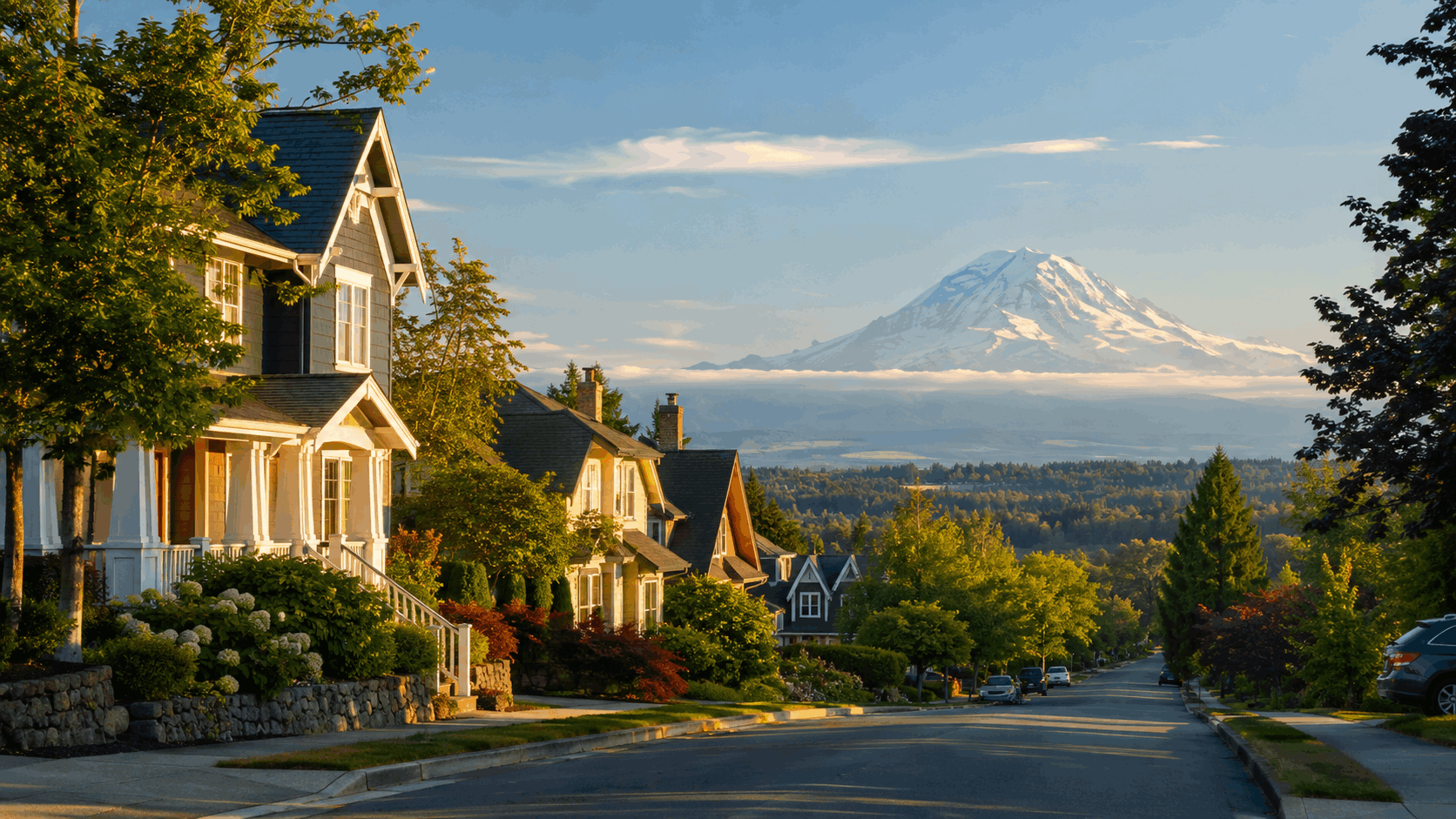
Mount Rainier is 40 miles southeast and visible from a startling number of streets here on clear days. Locals will tell you the mountain "is out" when it is, and they'll never quite get over it.
What Homes Actually Cost
Here's the market as of this summer:
- Pierce County median closed price: $589,999 (July 2026), up from $579,950 a year earlier
- ZIP 98374, South Hill area: median sale price $604,858 in June 2026, 213 homes sold
- Median days on market, 98374: 18 days, selling at 100% of list price
- Active inventory countywide: 2,918 listings, up roughly 19% year over year
- Months of inventory: 3.04 — more choice than a year ago, still on the tight side
- 30-year fixed mortgage rate: 6.66% as of Freddie Mac's August 27, 2026 survey
If you're coming from King County, that median will read as a discount. If you're coming from the Midwest or the Southeast, it won't. Both reactions are correct, and I'd rather you know which one you're having before you get on a plane.
Worth knowing: builders are active across South Hill, Graham, and Frederickson, and new construction competes directly with resale homes here. Builder incentives can make a new home pencil differently than the sticker suggests — it's worth comparing both tracks rather than assuming one is cheaper.
Getting Around, and Getting to Seattle
This is where Puyallup earns a lot of its relocation traffic.
- Sounder commuter rail. The Puyallup station sits downtown and reaches King Street Station in Seattle in about 49 minutes, with 13 round trips on weekdays. For anyone who has driven I-5 north at 7 a.m., this is the entire argument.
- Sound Transit Express Route 578 runs north through Sumner, Auburn, and Federal Way to downtown Seattle.
- Pierce Transit connects the station to South Hill, South Hill Mall, Tacoma, and Federal Way, including the Puyallup Connector route.
- Driving means SR 512, SR 167, and SR 161 (Meridian). Tacoma is roughly 20 minutes off-peak; Seattle by car is 45 minutes on a good day and considerably worse on a normal one.
- The SR 167 Completion Project is building a six-mile expressway linking Puyallup directly to the Port of Tacoma and I-5. It will be electronically tolled at two points, and WSDOT expects it to open to traffic in 2029. The project also includes the 12-mile shared-use spuyaləpabš Trail, named for the Puyallup Tribe of Indians.
If your work is at JBLM, note that the base pulls housing demand from across the county, and commute patterns from Puyallup, Spanaway, and Graham differ enough to be worth mapping before you pick a submarket.
Taxes: The Part That Surprises People
- No state income tax. Washington doesn't have one. For households relocating from California, Oregon, or the East Coast, this is often the largest single change in the monthly math.
- Sales tax is high to compensate. The combined state and local rate in Puyallup runs just over 10%. Check the current rate for a specific address through the Department of Revenue's lookup — rates vary by location and change quarterly.
- Property taxes in Pierce County generally land somewhere around 1% of assessed value, but levy rates vary meaningfully by taxing district. Verify the actual figure for any specific parcel with the Pierce County Assessor-Treasurer before you budget it.
- Real estate excise tax (REET) is charged on the sale of real property and is customarily paid by the seller — so it matters when you sell, not when you buy. Washington uses a graduated state rate of 1.10% up to $525,000 and 1.28% from there to $1,525,000, plus a local rate on top.
The Weather Question
You've heard it rains. What people don't tell you is the shape of it.
The rain here is mostly a gray, low-intensity drizzle spread across October through May rather than dramatic downpours, and summers are genuinely excellent — dry, mild, and long-lit, with sunsets past 9 p.m. in June. The tradeoff is winter daylight that ends around 4:30 p.m. Some people love the whole package. Some people buy a very good rain shell and a light therapy lamp. Very few people are neutral about it.
Buying a Home in Washington Works Differently
If you've bought elsewhere, expect a different vocabulary. These are the terms that catch relocating buyers off guard:
- Mutual acceptance — the moment both parties have agreed to all terms. Every contingency timeline in your contract counts from that date, not from the offer date.
- Form 17 — Washington's seller disclosure statement. You'll receive it and have a defined window to review and respond.
- Earnest money — your good-faith deposit, held in trust, credited to you at closing.
- Escrow closings. Washington is an escrow state, not an attorney-closing state. A neutral escrow officer handles the paperwork and disburses funds.
- Sewer scope inspections — routine here on older homes, because Western Washington's housing stock includes plenty of clay and cast iron sewer laterals.
- Septic and well inspections — necessary on rural properties east and south of the city. Septic sales require a Report of System Status through the Tacoma-Pierce County Health Department.
- NWMLS forms — Washington uses its own statewide forms rather than the national ones, including specific contingency forms for financing, inspection, and the sale of a buyer's existing property.
- Written service agreements — since January 1, 2024, state law requires a written agreement establishing representation and compensation before a broker represents you.
None of this is difficult. It's just unfamiliar, and unfamiliar is where relocating buyers lose earnest money and negotiating position.
How I'd Sequence a Move Here
- Get pre-approved with a lender licensed in Washington before you shop, so your offer is credible from day one.
- Spend a weekend in the actual submarkets — downtown, South Hill, and one of the outlying areas. They're twenty minutes apart and feel nothing alike.
- Drive your commute at the hour you'd actually drive it. Not at noon on a Sunday.
- Decide on services before features. City sewer and water versus septic and well changes your inspection list, your maintenance budget, and your long-term costs more than a kitchen finish will.
- Line up your sale, if you have one. If you're buying here before selling there, the structures in buying before you sell apply the same way across state lines.
Frequently Asked Questions
How much do you need to earn to buy a home in Puyallup?
With a Pierce County median close of $589,999 in July 2026 and 30-year rates near 6.66%, the payment depends heavily on your down payment, property taxes for that specific parcel, and insurance. The practical step is a full pre-approval with a Washington-licensed lender, which gives you a real number instead of a rule of thumb.
How long is the commute from Puyallup to Seattle?
The Sounder train from Puyallup station reaches King Street Station in about 49 minutes, with 13 weekday round trips. Driving takes roughly 45 minutes without traffic and substantially longer during peak hours on I-5.
Is Puyallup a good place to buy new construction?
There's active building across South Hill, Graham, and Frederickson, so new construction is a real option and it competes directly with resale inventory. Compare builder incentives against resale pricing and condition rather than assuming one path is automatically cheaper.
What's the difference between Puyallup and South Hill?
South Hill is the plateau south of the valley floor, with most of the newer subdivision housing and the Meridian retail corridor. Downtown Puyallup and the valley floor hold the older, more walkable housing stock near the fairgrounds and the Sounder station. They price differently and appeal to different buyers.
Do I need flood or hazard insurance in the Puyallup Valley?
It depends entirely on the parcel — portions of the valley floor sit in mapped flood zones, and Pierce County also has mapped volcanic hazard zones along the river valleys. Your agent should pull the mapping for any specific address before you write an offer, and your insurance quote should reflect it.
The Bottom Line
Puyallup works for people who want more house and land than King County offers, a real transit option into Seattle, and a valley that still looks like the Pacific Northwest people move here imagining. The buying process runs on Washington-specific contracts and inspections, and the submarkets vary more than the map suggests — which is exactly where local guidance pays for itself.
If you're considering a move to Pierce County, text RELOCATE to 253-677-5765 for a personalized consultation covering neighborhoods, housing options, commutes, and what life here actually looks like — before you book a house-hunting trip.
Already own a home you'll need to sell first? Start with how to buy before you sell.
About Josh Barnard
Josh Barnard is the founder of The Barnard Group and has spent over 20 years helping families navigate some of life's biggest moments through real estate. Known for his “Work Hard. Be Kind.” approach, Josh combines expert market knowledge, innovative marketing, and genuine care to help homeowners make confident decisions about their next chapter. Whether someone is buying their first home, moving up, downsizing, or relocating to Pierce County, his mission is simple: serve people well, create unforgettable experiences, and help families build a life they love.
Sources
- NWMLS — Pierce County Comprehensive Report, July 2026
- Redfin — 98374 Housing Market (June 2026)
- Freddie Mac — Primary Mortgage Market Survey, August 27, 2026
- Sound Transit — Sounder S Line and Puyallup station service
- WSDOT — SR 167 Completion Project
- Washington Department of Revenue — Local sales & use tax rates
- Washington Department of Revenue — Real estate excise tax
GET MORE INFORMATION